How to Improve Garage Storage When Ceiling Height and Wall Space Are Both Limited
A garage with a low ceiling and barely any free wall feels like it has already made up its mind: there is simply nowhere left to put anything. The floor is full, the walls are broken up by doors, windows, and the breaker panel, and anything hung from the ceiling seems destined to collide with the garage door or the car roof.
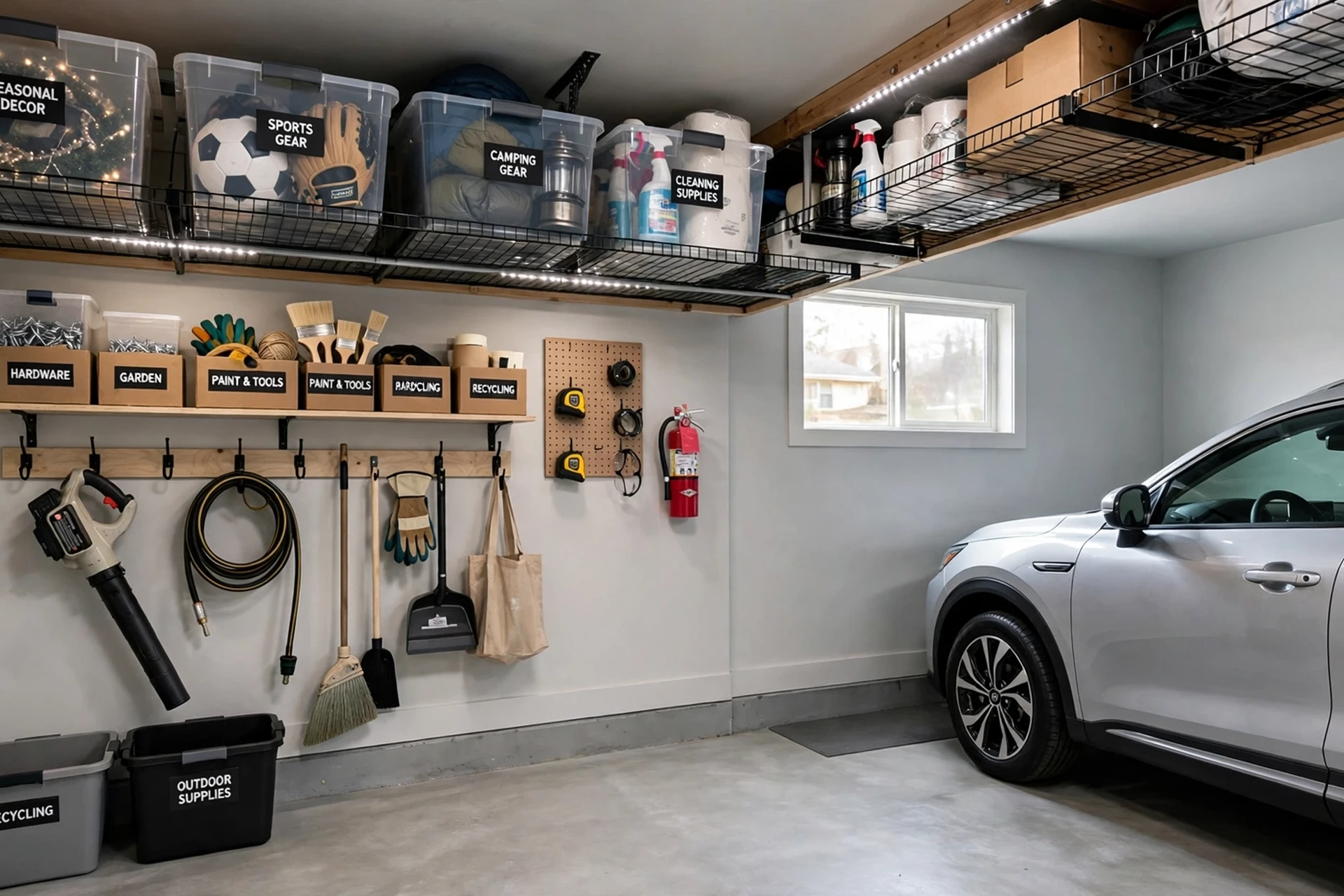
In a garage where ceiling height and wall space are both limited, the best plan uses shallow overhead racks in the dead zones above the garage door and parked cars, slim wall systems on the few usable wall sections, and rolling storage under benches — keeping every load light, labeled, and clear of door tracks and vehicle roofs.
Start With a Tape Measure, Not a Shopping Cart: Mapping the Inches You Actually Own
Before buying a single hook, spend twenty minutes measuring. Low-ceiling garages punish guesswork: a rack that drops two feet from a seven-foot ceiling can leave a tall vehicle unable to park. Measure the ceiling height at several points, then measure your tallest vehicle, including any roof rack, and the clearance under the open garage door, which often hangs lower than the ceiling itself.
Next, map the wall you do have. Mark every obstruction — door tracks, the opener rail, electrical panels, water heaters, windows, and door swings — and note the clear stretches between them. Even a two-foot strip of bare studs can hold a surprising amount once you stop thinking of walls as one continuous surface.
The Dead Zones Above Doors, Cars, and Corners Still Count When Headroom Is Scarce
Every garage has pockets of space that are useless for standing or parking but perfect for storage. The wall above the garage door opening often sits empty, and a shallow shelf mounted high there, clear of the door’s travel path, can hold light, flat items such as folded tarps or camping chairs. The same logic applies above the hood and trunk of a parked car: these fringe zones sit beyond the tallest part of the vehicle, so a slim rack or shelf there can use a foot of vertical space without ever threatening the roof.
Corners work the same way. An L-shaped or diagonal shelf tucked into a corner uses space a rectangular rack cannot reach, and corner systems can reclaim a meaningful amount of volume from what looks like wasted geometry.
Slim Overhead Racks That Fit a Low Ceiling Without Stealing Your Parking Clearance
Overhead racks are not automatically off the table in a low garage — but the deep, fixed racks sold for tall garages are. What you want is a shallow-profile rack, some of which extend only about 12 to 16 inches below the ceiling, or an adjustable rack set to its shortest drop. Mounted over the fringe zones above, a slim rack can hold bulky but light items — holiday decorations, camping gear, luggage, out-of-season sports equipment — that otherwise colonize the floor.
Capacity matters more than size here. Most consumer overhead racks are rated around 400 to 600 pounds, but only when bolted into ceiling joists with the weight spread evenly, and a low-ceiling installation should stay well under the rating, since retrieving items from a shallow rack often means working on a step stool. Store only light, bulky things up high; heavy tools, paint cans, and anything you reach for weekly belong lower down.
Walls That Work Harder: Slatwall, Pegboard, and Between-the-Studs Shelving
When wall space is scarce, the wall you do have must hold more per square foot. Slatwall panels and track systems do this well because their hooks, baskets, and shelves can be rearranged as needs change, and they use the full height of an available strip rather than a single row of nails. Pegboard is the budget version of the same idea: a panel mounted about an inch off the wall gives hooks clearance, and outlining each tool in marker makes it obvious when something is missing.
If your garage walls are unfinished, there is one more trick: shelving built between the studs. The cavity between two studs is roughly three and a half inches deep — too shallow for a paint can, but perfect for spray cans, tubes of caulk, and small oil bottles. A few short shelves screwed between studs turn dead wall cavities into a tidy parts library for little more than scrap lumber.
A Rolling Cart Beats a Fixed Cabinet When Floor Space Is the Tightest Squeeze
Fixed cabinets are the default garage upgrade, but in a garage short on both height and wall, they have a weakness: they claim floor space permanently, even on days you need that floor for a project or a second vehicle. Rolling storage flips that trade. A lockable tool cart, a utility cart, or a workbench on casters can live tucked under a bench or against a short wall, then roll out to where the work is happening. Locking casters are non-negotiable on a sloped garage floor — an unlocked cart will migrate on its own, usually toward your car.
Matching Each Storage System to the Surface It Actually Fits
Shortlist options against your own measurements before you buy.
Costs are broad estimates that vary by size, brand, and region — a budgeting starting point, not a quote.
Getting Bikes, Ladders, and Long Tools Off the Floor Without a Tall Wall
Bikes, ladders, and long-handled tools are the worst offenders in a small garage because they are long in exactly the direction you cannot spare. The fix is to store them in the orientation that uses your scarcest dimension least. A bike hung vertically by its front wheel occupies a strip barely wider than its handlebars, and two or three bikes can share a short wall section if their heights are staggered.
Ladders belong flat against the ceiling or high on a wall, never leaning in a corner where they eat floor space and invite a fall. Ceiling-mounted ladder hooks can park an extension ladder above head height along a wall, clear of the door tracks.
A Weekend Sequence for Reclaiming a Cramped Garage, Bay by Bay
Trying to reorganize a whole garage in one chaotic afternoon is how projects stall halfway, with everything on the driveway. Work bay by bay instead:
Empty one bay completely and sort everything into four piles: keep in the garage, move elsewhere, donate or sell, and discard.
Clean the empty bay, then mark your parking footprint, door swings, and obstruction zones on the floor with painter’s tape.
Install the highest storage first — slim racks, joist-bay hooks, and above-door shelves — while the bay is still empty.
Mount wall systems on the clear wall sections, place rolling storage in its parking zone, and test that car doors still open.
Label every bin and zone before moving to the next bay.
Where Low-Ceiling Garage Storage Goes Wrong: Overloading, Blocking Doors, and Buried Bins
The most common failure in a low garage is overloading the ceiling. A rack rated for several hundred pounds is only as strong as its joist connections, and installers sometimes anchor into drywall or a single joist instead of spreading the load across several. If your joists are damaged, undersized, or spaced unusually far apart, have a professional assess them before hanging anything heavy overhead.
The second failure is blocking movement. Racks that hang over the door tracks can jam the door; cabinets beside the door can trap you if it swings inward; and bins stacked in front of the electrical panel violate the working clearance most codes require around panels. Keep door tracks, opener rails, and panels completely clear, and test the door through a full open-close cycle after any new installation.
What a Tight Garage Makeover Costs, From a Saturday’s Worth of Hooks to a Full Wall System
A squeezed garage does not demand a big budget, but it does reward spending in the right order. Start with the cheapest wins: a pegboard panel and hooks, between-studs shelves from scrap lumber, and labeled bins can transform a single bay for an estimated $100 to $250 in materials.
The next tier — a slim overhead rack, a slatwall section, and a decent rolling cart — typically adds an estimated $400 to $900. This is the sweet spot for most low-ceiling garages. A full wall system with cabinets, a motorized platform, or professional installation pushes the total into the estimated $1,500 to $4,000 range, and is worth considering only after the cheaper tiers have shown which categories genuinely need enclosed storage.
Keeping a Squeezed Garage Safe: Loads, Labels, and Knowing the Pro Line
Safety in a low garage is mostly about weight, clearance, and chemistry. Never store paint, solvents, or fuel above head height, where a falling container becomes a hazard and a leak drips onto everything below. Keep flammables in a locked, ventilated cabinet away from ignition sources such as water heaters and furnaces. Store heavy items low and light items high, and recheck rack fasteners once a year — vibration from the garage door opener slowly loosens hardware over time.
Call a professional when the job touches structure, electricity, or gas: assessing questionable joists before hanging a rack, adding circuits for lighting over a new work zone, or relocating anything connected to a gas line.
Your Low-Ceiling Garage Storage Checklist Before You Buy Anything
- Ceiling height measured at several points, plus tallest vehicle height and open-door clearance.
- Every wall obstruction marked: door tracks, opener rail, panels, heaters, windows, and door swings.
- Parking footprint taped out, including open car doors and a walkway to the house door.
- Each item category assigned to a surface: fringe zone, wall strip, rolling cart, or elsewhere in the home.
- Rack drop height and load rating checked against your measurements, with joist spacing confirmed.
- Bins uniform, labeled on the visible side, one category each.
- Garage door tested through a full open-close cycle after every new installation.
- Flammables in a locked, ventilated cabinet, never stored overhead.
Garage Storage Questions From Owners Squeezed on Height and Wall Space
Can I install an overhead rack in a garage with a seven-foot ceiling?
Sometimes, but only in the right spot. A slim rack dropping about a foot can work over fringe zones — above the hood, trunk, or garage door — where nothing tall needs to pass beneath it. Over the main parking area, that same rack may leave too little clearance, so measure your car’s height plus the rack’s drop before buying.
What should I store overhead when headroom is tight?
Light, bulky, rarely used items: holiday decorations, camping gear, luggage, and out-of-season sports equipment. Keep heavy tools, paint, chemicals, and anything you need weekly at waist height or below.
How do I store tools if I only have a few feet of bare wall?
Make that strip work harder with slatwall or pegboard, which holds far more per square foot than loose nails, and add between-studs shelving for small cans and bottles. Move bulky tool storage to a rolling cart so the wall only needs to hold hand tools and accessories.
Are rolling carts really better than cabinets in a small garage?
Where floor space is tightest, yes — a cart’s footprint is temporary. It rolls out for a project and tucks away afterward, while a fixed cabinet claims its floor space every day. Cabinets still win for dust protection and security.
Will hanging bikes vertically damage the wheels?
No, when done correctly. Hanging a bike by its front wheel on a proper hook does not damage a standard wheel, though very heavy e-bikes may be better on a floor stand or a frame-supporting wall mount. Stagger heights when hanging multiple bikes so handlebars and pedals do not clash.
Do I need a professional to install an overhead rack?
Not always, but get one if your joists are damaged, unusually spaced, or of unknown strength, or if the rack will carry a heavy load. For a light, slim rack into sound joists, a careful DIY installation following the manufacturer’s instructions is reasonable.
A Squeezed Garage, Reclaimed: Start With the Measurements This Weekend
A garage with a low ceiling and little wall space is not a lost cause — it just needs a more deliberate plan. Measure first, claim the dead zones, and let rolling storage handle the rest.