Best Ways to Reduce Moisture in a Windowless Basement Bathroom – for Small Homes
A windowless basement bathroom can feel damp within minutes of a shower, and in a small home that dampness has nowhere easy to go. Without a window, steam stays in the room, settles on cold walls and mirrors, and slowly feeds mould, musty smells, and peeling paint. The room is also usually the smallest bathroom in the house, so even a short shower can push humidity far higher than in a larger, ventilated space.
The short answer is to give moisture a reliable way out and a backup way to be removed: a correctly sized exhaust fan ducted outside, run during and after every shower, plus a small dehumidifier and habits that let air move in and out of the room. No single gadget solves the problem alone. The fan removes steam at source, the dehumidifier handles what remains, and simple changes to doors, surfaces, and shower routines stop moisture from building up in the first place.
Why a Windowless Basement Bathroom Stays Damp Longer
Basements are naturally cooler and more humid than rooms above ground, because the surrounding soil holds moisture and the walls stay cold for much of the year. When warm shower steam hits a cold basement wall, it condenses, so the room can look wet even after the fan has run. In a small home, the bathroom is often enclosed by other rooms, so there is little natural air movement to dry it out between uses.
A windowless room also lacks the quick reset that opening a window provides. In a normal bathroom, a few minutes of fresh air can drop humidity sharply. Here, every bit of moisture must be removed mechanically or absorbed, which is why fan size, ducting, and run time matter more than they do elsewhere. If the fan is undersized, vents into a ceiling cavity instead of outside, or is switched off as soon as the shower ends, humidity stays high for hours, and mould gets the damp, still conditions it needs.
Sizing and Ducting a Basement Bathroom Exhaust Fan That Actually Works
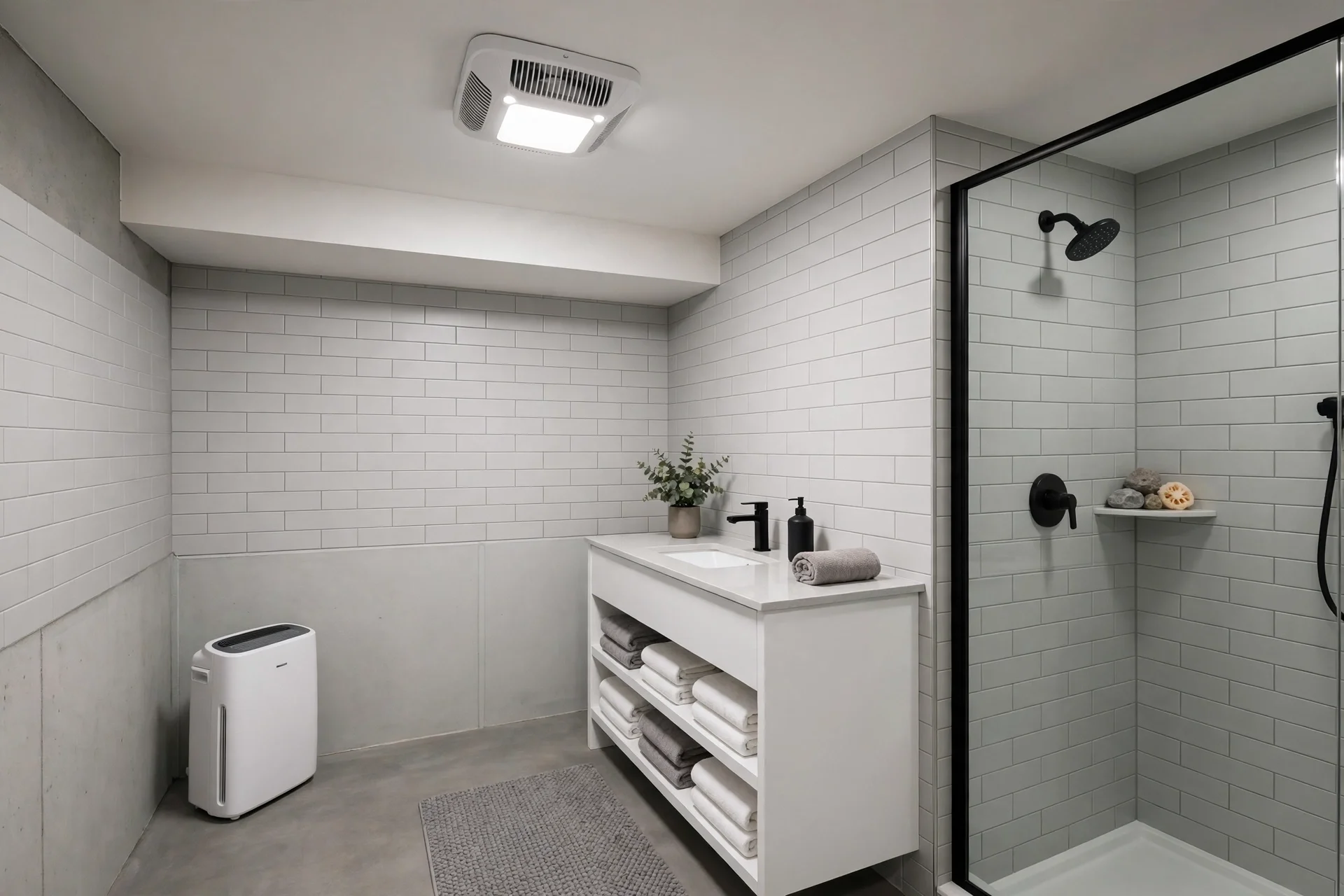
Start with fan capacity. A common rule is to size the fan to the room volume and aim for about eight air changes per hour, which for a small bathroom often means a fan in the region of 80 to 110 cubic feet per minute, depending on the exact room size. A fan that is too small will leave steam hanging in the air, while a fan that is far too large can be noisy and may pull conditioned air from the rest of the house unnecessarily. Check the manufacturer's guidance for your room dimensions rather than guessing from the size of the old fan.
Ducting is just as important as capacity. The duct must terminate outside the building, through a wall or roof vent, not into the ceiling void, an attic, or a crawl space, where the moisture will simply cause problems somewhere else. Use insulated ducting where it passes through cold spaces, so steam does not condense inside the duct and drip back, and keep the run as short and straight as practical. A timer or humidity-sensing switch is worth fitting, so the fan keeps running for twenty to thirty minutes after a shower even if someone forgets to leave it on.
Using a Dehumidifier as Backup, Not as a Replacement Fan
A compact dehumidifier is a useful second line of defence in a windowless basement bathroom, especially in summer or in a home where the basement itself is damp. It pulls moisture from the air continuously, helps keep surfaces dry between showers, and can make the room feel less clammy. Choose a model sized for a small room, with a tank that is easy to empty or, better, a drain hose if a suitable drain is nearby, and a humidistat so it does not run constantly.
It is important not to treat a dehumidifier as a substitute for an exhaust fan. A dehumidifier recirculates the same air after removing moisture; it does not remove stale air, odours, or airborne contaminants, and in many building rules it does not count as ventilation on its own. Think of the fan as the main route out for steam, and the dehumidifier as the helper that keeps background humidity in a healthy range, roughly between 40 and 50 percent, between uses. Empty the tank regularly and clean the filter, or the helper will stop helping.
Letting Air In: Doors, Gaps, and Whole-House Airflow in a Small Home
An exhaust fan can only remove air if replacement air can get in. In a small, tightly closed bathroom, a fan may struggle because the room is effectively sealed. A simple fix is a door undercut of about an inch, or a louvered door, which lets air flow in from the hallway while the fan pushes moist air out. A transfer grille in the wall can do the same job where a door change is not practical, and it is worth checking that the hallway itself has some air movement, for example from a central heating or cooling system.
After a shower, leaving the bathroom door open for a while helps moist air disperse into the larger house, where it can be handled by the home's heating, cooling, or dehumidification system, rather than staying trapped in a tiny room. This only works if the rest of the house is not already very humid, and it is not a substitute for running the fan, but as a habit it makes a noticeable difference. In a small home, small airflow changes like these often matter more than expensive equipment, because the rooms are so closely connected.
Surfaces, Grout, and Shower Habits That Keep a Small Basement Bathroom Drier
Surfaces make a difference to how long moisture lingers. Smooth, non-porous tiles, a well-sealed grout, and a shower enclosure that contains spray will dry faster than porous paint, unsealed grout, and a curtain that stays wet. Reseal grout and caulk when they crack or darken, wipe down shower walls after use where practical, and hang towels and bath mats where air can reach them rather than in a damp pile on the floor. These habits take minutes and reduce the moisture load the fan and dehumidifier have to handle.
Shower habits matter too. Shorter, slightly cooler showers produce less steam, and running the fan from before the shower starts, rather than switching it on halfway through, catches steam at its peak. A squeegee on glass and tile takes seconds and removes a surprising amount of water before it can evaporate into the room. None of this requires a renovation, which is the point: in a small home, the cheapest moisture controls are often the ones you use every day, not the ones you install once.
Basement Bathroom Moisture Fixes Ranked by Impact and Disruption
If you are deciding where to spend money first, start with the fan and its ducting, because nothing else compensates for steam that never leaves the room. Next, add a timer or humidity control so the fan runs long enough, and a door undercut or grille so air can enter. A dehumidifier comes third, as background support, followed by surface repairs such as resealing grout, fixing leaks, and improving the shower enclosure. Larger work, such as adding a new duct route or addressing basement waterproofing, should follow only after the basics are right, or you risk paying for a big fix while a small one was still failing.
Basement Bathroom Moisture Mistakes That Feed Mould in Small Homes
The most damaging mistake is a fan that vents into the wrong place. A fan that blows steam into a ceiling void or crawl space does not solve dampness; it moves it to a hidden space where mould can grow unseen and timber can rot. Another common mistake is switching the fan off immediately after a shower, which leaves the peak humidity in the room. A third is relying on air fresheners or a ventless fan that only recirculates air: the room may smell better for an hour, but the moisture is still there.
Ignoring small leaks is equally costly in a basement bathroom. A dripping shower valve, a slow toilet seal leak, or a cracked grout line can keep a wall damp permanently, and no fan will dry a surface that is constantly being wetted. Check under the sink, around the toilet base, and behind the shower trim occasionally, and fix leaks promptly. If dampness persists despite a good fan, a dehumidifier, and sound surfaces, it may be a basement waterproofing or plumbing issue, and that is the point to call a professional rather than adding more gadgets.
Final Thoughts: A Drier Windowless Basement Bathroom – for Small Homes
A windowless basement bathroom in a small home can be kept dry, but only if moisture has a planned way out every time the shower runs. Fit a fan that is big enough and ducted outside, let it run long enough, let replacement air in, and use a dehumidifier as backup. With those basics in place, plus dry surfaces and sensible shower habits, the room should smell fresh, stay free of mould, and stop feeling like the dampest room in the house. Check the fan, duct, and seals once a season, and the system will keep working quietly in the background.
Windowless Basement Bathroom Moisture FAQs – for Small Homes
How long should I run the fan after a shower in a windowless bathroom?
Run it during the shower and for twenty to thirty minutes afterwards. A timer or humidity-sensing switch makes this automatic, so the room is not left damp because someone forgot to leave the fan on.
Can a dehumidifier replace an exhaust fan in a windowless bathroom?
No, not as the main ventilation. A dehumidifier removes moisture but recirculates the same air, so it does not remove stale air or odours, and it generally does not count as ventilation under building rules. Use it alongside a fan ducted outside, not instead of one.
What humidity level should a basement bathroom aim for?
A practical target is roughly 40 to 50 percent relative humidity between uses. Much higher for long periods encourages mould and musty smells, while much lower can feel uncomfortably dry and may indicate over-drying of the space.
Why does my basement bathroom smell musty even with a fan?
Common causes are a fan that is undersized, ducted into a ceiling void, or switched off too soon; a hidden leak; or damp basement walls. Check the duct route, the fan run time, and for leaks before assuming the fan itself is faulty.
Is a louvered door really helpful for bathroom ventilation?
Yes, in a small, sealed bathroom it can make a real difference, because an exhaust fan needs replacement air to work well. A door undercut or transfer grille serves the same purpose if a louvered door does not suit the home.
When should I call a professional about basement bathroom dampness?
Call one if dampness persists despite a correctly ducted fan and a dehumidifier, if you find mould over a large area, if there is a plumbing leak you cannot locate, or if basement walls show water ingress, efflorescence, or structural cracking.