Irish Tartans Exist — Here’s How to Find Yours
Tell someone with Irish roots that they have a tartan and watch the reaction: half delight, half suspicion. Isn’t tartan Scottish? Wasn’t the Irish kilt a modern invention? The suspicion isn’t baseless — the two traditions really are different — but the conclusion is wrong. Ireland has a genuine, structured, and steadily growing tartan tradition of its own: county setts for all thirty-two counties, a cluster of family tartans for the great Irish surnames, national patterns open to everyone, and even a piece of woven cloth pulled from an Ulster bog that predates most Scottish clan setts on record.
For the seventy-million-strong Irish diaspora, that adds up to something practical: whoever you are and wherever your people left from, there is an Irish tartan with a defensible claim on you. Here’s how the system works and how to run the search.
First, the honest history
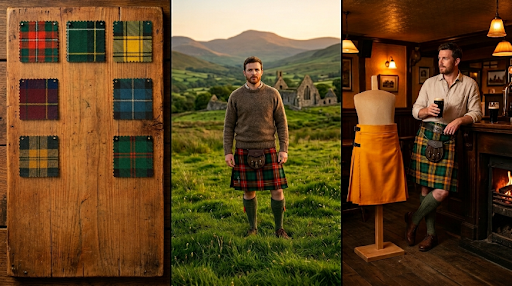
Scotland’s clan-tartan system — specific sett equals specific family — crystallised in the early nineteenth century atop older Highland weaving traditions. Ireland’s textile identity ran differently: the colour of Gaelic Ireland was saffron, the deep yellow of the léine tunic, and later of the solid saffron kilts that Irish pipe bands and regiments adopted and still wear. Chequered cloth wasn’t foreign, though — Irish weavers produced it for centuries, and the famous Ulster tartan proves it: a woven tartan cloth recovered in 1956 from a bog at Dungiven, from a suit of clothing dated to around 1600. Reconstructed and registered, its rusty, earth-toned sett is now worn as the tartan of the province — cloth with a better archaeological pedigree than the vast majority of Scottish setts.
The modern Irish system was built deliberately, mostly in the twentieth century, on a sensible foundation: since Irish identity organises by place — county, province, parish — more than by clan, Irish tartans would be primarily geographic. That decision is what makes the whole tradition so usable today.
The county system: everyone qualifies
The core of Irish tartan is the county sett: registered patterns for all thirty-two counties, north and south. Cork, Kerry, Galway, Mayo, Donegal, Antrim, Dublin, Tipperary — each has its own tartan, most built on green and earth-toned grounds with distinguishing overstripes, deliberately harmonious as a family of designs while remaining individually identifiable. The convention is beautifully simple: you wear the county your people came from. No sept lists, no chief’s approval, no genealogical gymnastics — if your grandmother left from Kerry, the Kerry tartan is yours, full stop.
This is why the county system has become the diaspora’s favourite doorway. Emigration records, ship manifests, and family lore almost always preserve a county even when the townland and the spelling of the surname have blurred — and a county is all the system asks. Searching Irish tartans by name — county names, that is — is consequently the single fastest heritage-to-cloth pipeline in the entire tartan world: one known place-name and the question is settled.
Above the counties sit the four provinces — Ulster, Munster, Leinster, Connacht — each with its own sett for those whose knowledge stops at the regional level, and that bog-certified Ulster pattern doing double duty as both province tartan and national treasure.
The family tartans: the great names get their own
Layered over the geography is a growing collection of Irish family tartans — designed setts for the great Hiberno surnames: Murphy, Kelly, O’Brien, O’Neill, O’Connor, Kennedy, Ryan, Byrne, Walsh, Fitzgerald, Sullivan, and a lengthening roll of others. These are modern designs, registered in recent decades, and honest retailers say so — no one claims Brian Boru wore the O’Brien sett. But “modern” is not “meaningless”: every tartan everywhere was designed by someone, sometime; the Irish family setts simply have shorter paperwork trails than the Victorian-era Scottish ones. What they offer is exactly what clan tartans offer — a wearable, repeatable, giftable pattern attached to your name — and for the mega-surnames of Ireland, that’s a genuine identity object: a Murphy family wedding in Murphy tartan requires no further justification.
The practical hierarchy for choosing, then: family sett if your surname has one; county sett always; province sett as the wider net. Many families happily run two — the Murphy tie over the Cork kilt.
The national patterns: the open door
Completing the system are the all-Ireland setts, free to anyone with Irish blood, Irish sympathy, or simply Irish taste: Irish National, the green-ground standard-bearer; Tara, the elegant heritage sett named for the hill of the high kings; St Patrick’s, in blues and greens for the season that needs no explanation; and a family of modern commemoratives. These are Ireland’s answer to Scotland’s Black Watch — the patterns that exist so nobody is left outside the tradition — and they’re the correct choice for the person whose Irishness is certain but whose paperwork is not.
Wearing it: same cloth, Irish grammar
Irish tartan wears exactly like Scottish tartan mechanically — kilts, skirts, ties, sashes, scarves, waistcoats — with a few grammar notes of its own. The saffron kilt remains the deepest-rooted Irish option and pairs magnificently with a county tartan tie or fly plaid, a combination pipe bands have run for a century. Irish weddings have adopted county-tartan kilts for grooms and parties with real enthusiasm — a Galway sett at a Galway family’s wedding lands the way a clan sett does in Scotland. And the diaspora calendar does the rest: St Patrick’s Day, Bloomsday, county association dinners, GAA finals watched at 6 a.m. in three time zones — occasions where the county on your kilt says precisely what a jersey says, at a better party.
Sourcing is the easy part now: the established Highland-wear houses weave the Irish registers alongside the Scottish — a specialist like Scottish Kilt Shop produces county, family, and national Irish setts across kilts and accessories to order — which means a Donegal tartan kilt is no harder to commission today than a Black Watch one.
Running your own search
The method in four steps: (1) fix the county — family records, ship manifests, and census entries preserve counties with remarkable stubbornness; (2) check the surname — if it’s one of the great names, a family sett may exist alongside the county option; (3) when records stop at “Ireland,” take the province or a national sett without embarrassment — they exist for exactly this; (4) verify the pattern against a proper register listing before buying, because Irish setts, like Scottish ones, have official thread counts and loose imitations in circulation.
Irish vs Scottish tartan: the five real differences
Since the two traditions get conflated constantly, here’s the honest comparison in five points.
Organising principle. Scottish tartan organises primarily by family (clan and sept), Irish primarily by place (county and province). Both systems have the other type as a secondary layer — Scotland’s district tartans, Ireland’s family setts — but the centre of gravity differs, and it changes how you search: surname-first in Scotland, county-first in Ireland.
Age of the system. Scotland’s clan-sett associations crystallised in the early 1800s atop older weaving; Ireland’s county system was consciously built in the twentieth century. Neither is ancient as a system — a fact that surprises people about Scotland far more than about Ireland — though individual cloths (Ulster’s bog tartan, the old Highland fragments) predate both.
The rules. Scottish convention carries soft etiquette about clan setts and connection; the Irish county system was designed without gatekeeping — residence or descent in the county is the whole qualification, and the national setts don’t even ask that.
The palette. Broad strokes only, but real: Irish setts lean green, saffron, and earth-toned as a family, reflecting both landscape and the saffron thread of Gaelic dress; the Scottish register spreads wider across reds and blues. Put a stack of county tartans beside a stack of clan tartans and you can usually sort them by eye.
The kilt underneath. Scotland’s kilt tradition is continuous and formalised; Ireland’s is a revival — saffron and tartan kilts adopted in the cultural renaissance of the last century-and-a-bit, now thoroughly established in pipe bands, weddings, and diaspora life. Younger, yes; less legitimate, no — every tradition on earth was young once, and Ireland’s kilt has already outlived most of the people who called it inauthentic.
The upshot for the wearer: the two systems are cousins, not copies — and knowing which grammar you’re speaking makes both easier to wear well.
The takeaway
Ireland didn’t copy Scotland’s tartan system — it built a better-organised one for how Irish identity actually works: place first, name second, everyone in. Between thirty-two counties, four provinces, the great family setts, and the national patterns — with a 400-year-old bog cloth anchoring the whole enterprise — the question was never whether there’s an Irish tartan for you. It’s only which of your claims you’d like to wear first. Start with the county your people left from, add the family sett if your surname carries one, and let the national patterns cover whatever the records lost — the tradition was built so that no Irish descendant ever has to answer the tartan question with no.